
Disclosure: Shed & Bench is reader-supported and may earn a commission from some products we recommend, at no extra cost to you. Read our affiliate disclosure.
There is no single best wood for outdoor furniture. The better choice depends on whether the piece sits on a dry deck or in contact with soil, how wet the climate is, whether you will keep a finish on it, and whether you are buying heartwood of a naturally durable species or a pressure-treated board labeled for that exposure.
This guide compares commonly used woods using published references, not shop tests by Shed & Bench. Decay-resistance groups come from Table 14-1 in the USDA Forest Products Laboratory Wood Handbook (FPL-GTR-282, 2021, Chapter 14). Use categories for pressure-treated wood come from the American Wood Protection Association (AWPA) Use Category System, as described in the 2026 U1 excerpt and in FPL’s treated-wood guidance. We have not built, weathered, or compared these woods, and this page does not give a service-life rating of our own.
You can also browse our free plans and the 10 weekend builds guide.
How outdoor wood fails, and how the handbook groups it
Two different problems show up on outdoor furniture. Weathering is the slow surface change caused by sun and moisture: color shift, checking, and gradual erosion. Decay is the growth of fungi in damp wood. The Forest Products Laboratory’s Wood Handbook notes that typical wood-decay fungi need moisture, and that decay progresses more readily at moderate temperatures when the wood is wet enough.
The handbook’s natural-durability ratings are for heartwood, not sapwood. It states that untreated sapwood of essentially all species has low resistance to decay and usually has a short service life under conditions that favor decay. If a board is mostly sapwood, do not treat the species name as proof of durability.
Table 14-1 groups heartwood into four classes: very resistant, resistant, moderately resistant, and slightly or nonresistant. The same table warns that precise ratings are not possible, that resistance varies within a species, and that “decay resistance may be less for members placed in contact with the ground and/or used in warm, humid climates.” Old-growth wood of a naturally durable species is often more resistant than second-growth wood. Use caution with naturally durable woods in structurally critical or ground-contact applications.
Those footnotes matter in a dry Southwest setting and in a humid Gulf or Florida climate: a piece that stays dry has a lower decay hazard than the same species left wet against soil. The table is about decay fungi, not a termite-resistance rating. In regions where termites are a concern, follow local practice; do not read a “resistant” grouping as a termite warranty.
Outdoor furniture woods at a glance
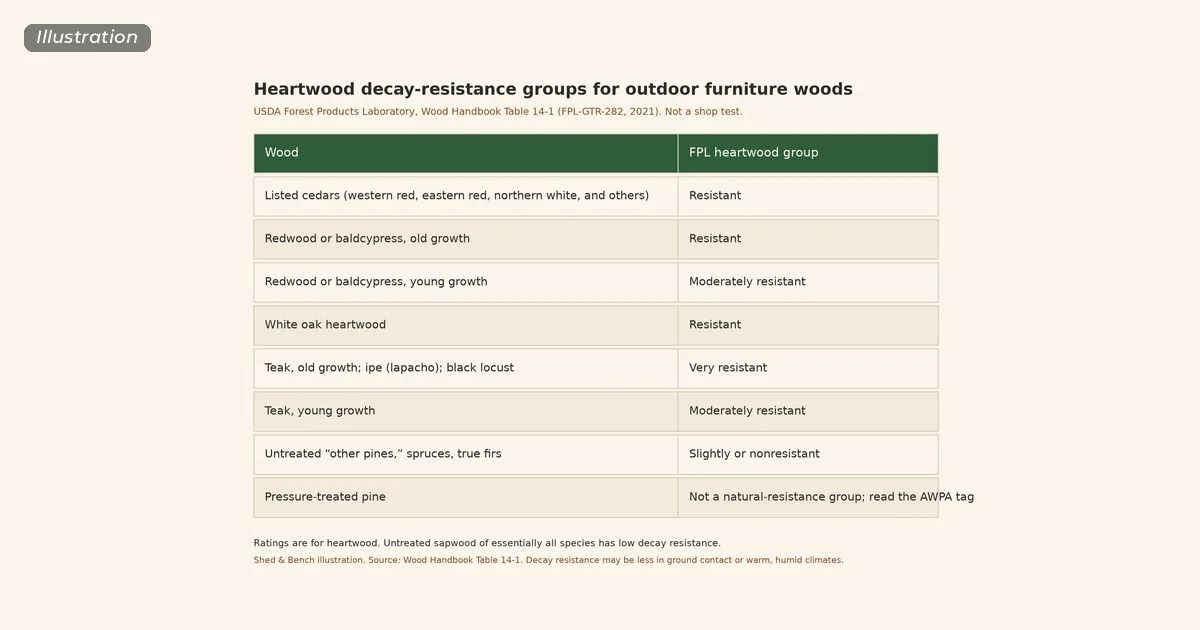
The table below is a reading of Table 14-1 and, for treated lumber, of AWPA use categories—not a ranked list or a test result.
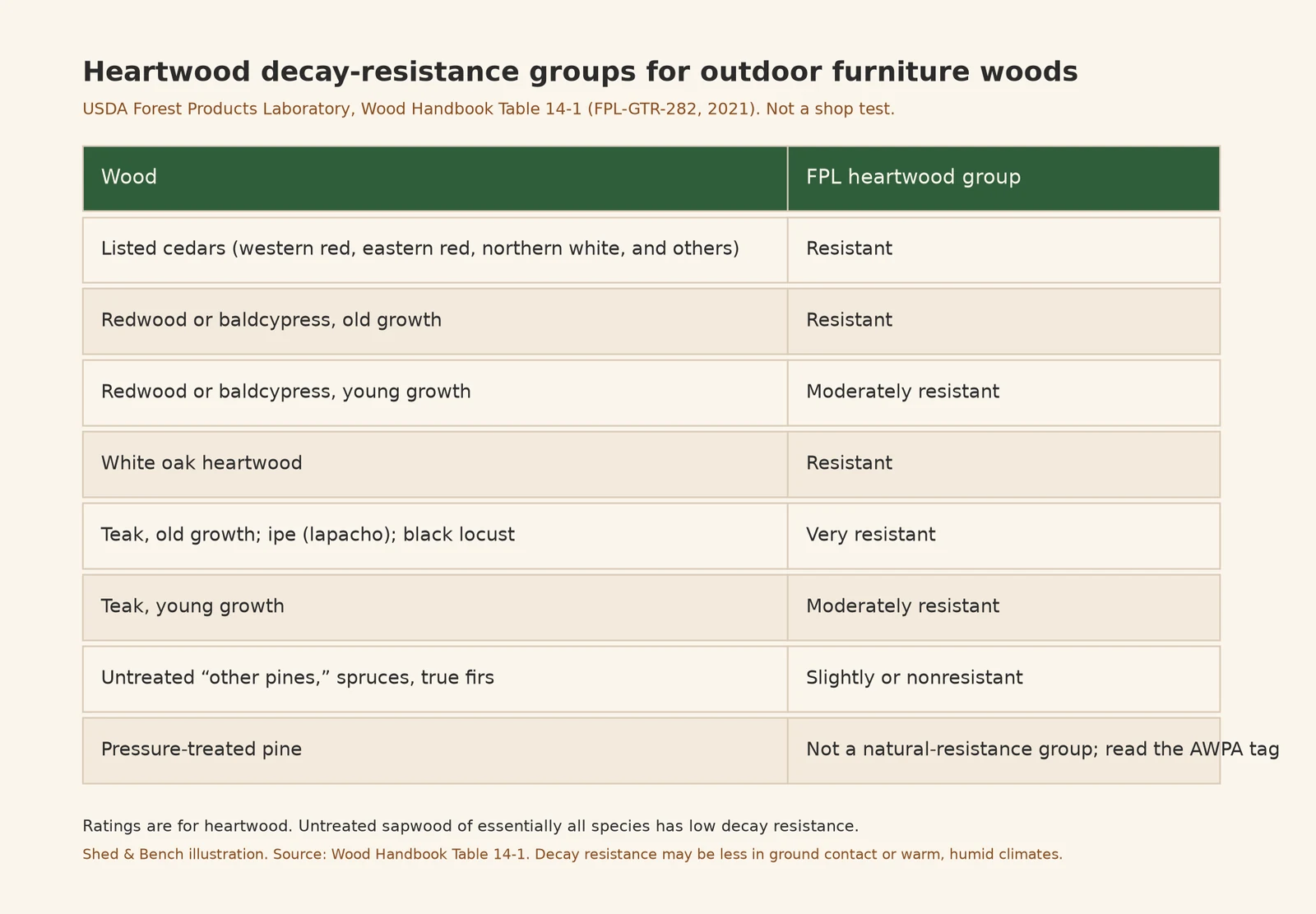
| Wood | USDA FPL heartwood group (Table 14-1, 2021) | Typical use of that grouping | Source watch-outs |
|---|---|---|---|
| Listed cedars, including western red, eastern red, and northern white | Resistant | Aboveground heartwood kept out of standing wet debris | Sapwood is not in this grouping. The table does not split cedar by old vs. young growth. |
| Redwood or baldcypress, old growth | Resistant | Aboveground heartwood | Young growth is listed separately as only moderately resistant. |
| Redwood or baldcypress, young growth | Moderately resistant | Lighter aboveground duty; the handbook says this category and the next usually need preservative treatment when the decay hazard is more than mild | A “redwood” or “cypress” stamp is not proof of old-growth resistance. |
| White oak (heartwood) | Resistant | Aboveground heartwood. A table footnote says more than one species is included, and some may vary. | Red oak is not listed in the resistant or very resistant columns. |
| Teak, old growth; ipe (lapacho); black locust | Very resistant | The handbook says very resistant heartwood generally gives satisfactory performance in ground contact | Young-growth teak is only moderately resistant. A “teak” name is not proof of old-growth heartwood. |
| Untreated pines other than the few old-growth pines listed as moderately resistant; spruces; true firs | Slightly or nonresistant | Indoor or dry use unless treated | Ordinary untreated construction pine sits in this column. |
| Pressure-treated Southern Pine or similar | Not a natural-resistance group; see the AWPA use category on the end tag | UC3A or UC3B above ground; UC4A if the piece sees ground-contact hazards | Above-ground stock is not automatically rated for legs in soil or trapped moisture. |
The handbook’s summary: resistant heartwood generally gives satisfactory service aboveground where a decay hazard exists, and very resistant heartwood generally gives satisfactory performance in ground contact. The moderately resistant and slightly or nonresistant groups will usually need some form of preservative treatment, except perhaps in mild decay conditions.
Cedar, redwood, and cypress
Western redcedar and the other cedars named in Table 14-1 (Atlantic white, eastern redcedar, incense, northern white, Port-Orford, and yellow cedar) are grouped as resistant heartwoods. That is why cedar is a common bench and table wood. It is not grouped as “very resistant,” and the handbook does not give a year-count for a cedar chair.
Buy heartwood when you can tell it from sapwood, keep joints and end grain from staying wet, and do not treat the species name as a substitute for a finish or for keeping the piece off wet ground. In a warm, humid climate, or where leaf litter sits around the legs, remember the footnote that resistance may be lower.
Redwood and baldcypress are split by growth in the same table: old growth is resistant; young growth is only moderately resistant. If the seller does not identify old growth, do not borrow the stronger grouping.
Teak, ipe, and white oak
Old-growth teak and ipe (lapacho) sit in the very resistant imported list—the grouping the handbook says generally performs satisfactorily in ground contact. Young-growth teak is only moderately resistant, the same broad band as young-growth redwood. A teak-versus-cedar comparison depends on which teak you actually have. We have not inspected or tested furniture-grade teak, and a product name is not proof of old-growth heartwood.
White oak heartwood is grouped as resistant, which can make it a reasonable aboveground furniture wood when you can buy heartwood. Red oak does not appear in the resistant or very resistant columns of Table 14-1, so this guide does not treat red oak as a naturally durable outdoor-furniture species on the basis of that table.
Ipe and other very resistant imported hardwoods are still covered by the handbook’s cautions about variability and reduced resistance in ground contact or warm, humid climates. This page is not a supplier review; check the seller’s documentation if certification matters for your purchase.
Pressure-treated pine: read the use category
Untreated “other pines,” which is how Table 14-1 describes the pines that are not the few old-growth species listed as moderately resistant, are grouped as slightly or nonresistant. Pressure treatment is how much of the construction pine sold for decks and outdoor projects is used outdoors.
AWPA’s Use Category System describes the exposure, not a brand of lumber. From AWPA’s U1 excerpt (2026) and the short descriptions AWPA publishes for code officials:
- UC3A is exterior, above ground, protected: either coated and built so water drains quickly, or kept fully protected from precipitation by design and maintenance.
- UC3B is exterior, above ground, exposed: not in contact with the ground. A coating is not required, though you may finish the wood for appearance. AWPA’s examples include decking, railings, and fence pickets.
- UC4A is ground contact, general use. It also covers some above-ground parts that see ground-contact-type hazards—for example, where soil, vegetation, or debris may build up and stay against the wood, or where air cannot circulate.
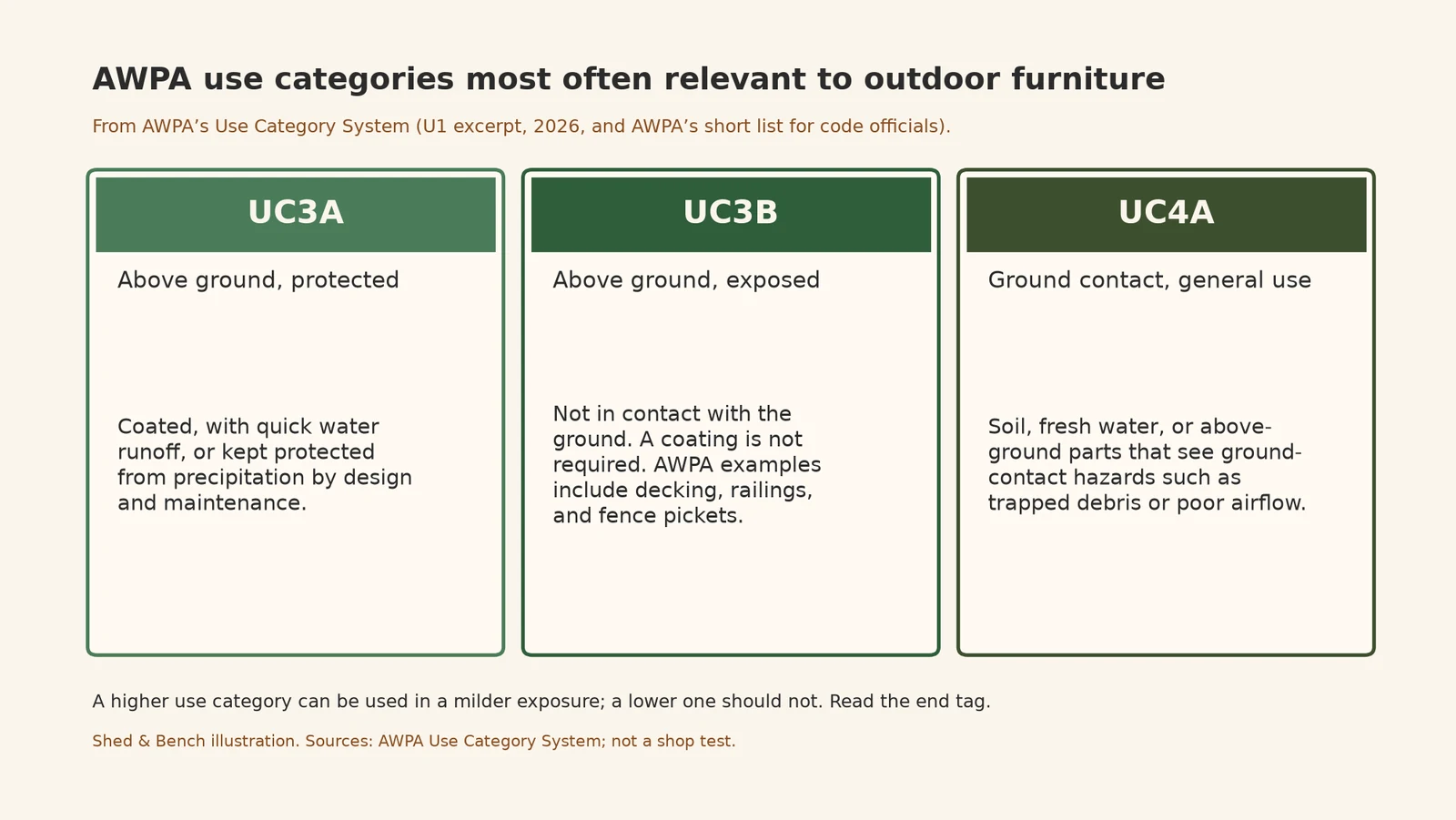
For a bench or table on a well-drained deck that dries after rain, an above-ground category (UC3B, or UC3A if it will stay coated with good runoff) matches that use. If the legs will sit on soil, stay buried in mulch or leaves, or trap water against a patio, look for UC4A (or a higher ground-contact category), not only an above-ground tag.
FPL’s Guidelines for Selection and Use of Pressure-Treated Wood (FPL-GTR-275, 2019) describes those three categories in the same broad way. Chapter 15 of the Wood Handbook (2021) lists waterborne preservatives commonly standardized for them, including alkaline copper quat (ACQ), copper azole (CA), and micronized copper azole (MCA). Under the U.S. EPA labeling described in that chapter, chromated copper arsenate (CCA) is permitted primarily for industrial applications, not as the default residential deck or furniture lumber.
Look at the end tag for the use category, the preservative, and the retention. Wood treated to a higher category can generally be used in a milder exposure; the reverse is not true. This guide does not quote prices or claim a year-count for a treated picnic table.
Finishes and maintenance
A durable species or a correct treatment reduces decay hazard. It does not stop weathering. Chapter 16 of the Wood Handbook (Hunt, 2021) is the source for the finish notes below. That chapter is written mainly around siding and decks, so the figures are FPL’s published expectations for exterior wood surfaces, not a test of a particular chair.
The chapter divides finishes into penetrating types (water-repellent preservatives, oils, and many oil-based semitransparent stains) and film-forming types (paints and solid-color stains). Penetrating finishes cannot crack or flake, but they need more frequent upkeep. Film-forming finishes can last longer on vertical, well-prepared surfaces but can peel, especially if the wood was left to “weather” in the sun first. FPL now advises against that older practice: sand sun-degraded wood back to a sound surface before a film-forming coat.
For horizontal outdoor surfaces such as decks and railings, Chapter 16 calls penetrating finishes an excellent choice, because film-forming finishes there often last no longer and are harder to refinish. A tabletop or bench seat is a horizontal, sat-on surface, so that is the closest match. Table 16-2 rates tinted penetrating deck finishes “high” for decking, with an expected service life of about 1–3 years for an average location in the contiguous United States, and about 2–6 years for a semitransparent stain on decking, depending on the surface. Those ranges depend on climate and exposure; they are not a warranty, and they are not from tests we ran. Table 16-3’s longer paint figures are for vertical exposure; do not borrow them for a horizontal seat. Paint, the chapter says, is not a preservative and will not prevent decay if the wood is moist.
Other points from the same chapter: finish sooner rather than later if you plan to paint or use a solid-color stain; treat end grain, which absorbs water faster; more pigment generally means more ultraviolet protection; and a “penetrating” product that dries to a sheen has formed a film, so wipe off the excess. Recoat when the finish no longer sheds water or when wear or mildew shows that a penetrating stain is spent.
Look for a product the maker rates for exterior use, and follow that label.
Keep the piece off standing water, and brush off leaves and soil that stay against the legs. A cover or a roof reduces both weathering and wetting, which is the condition decay fungi need.
Fasteners for outdoor use
Outdoor joints stay damp longer than indoor ones, and some treatments make corrosion more likely. FPL’s Guidelines for Selection and Use of Pressure-Treated Wood (FPL-GTR-275, 2019) states that corrosion of metal fasteners is a concern for any structure exposed to moisture, that some copper-containing waterborne preservatives can increase the corrosion rate compared with untreated wood, and that protection is still required because corrosion is always possible when moisture is present. The same guide notes that building codes require stainless steel, hot-dip galvanized, bronze, or copper fasteners in most of those instances, and that preservative suppliers may add recommendations for a given formulation.
For outdoor furniture, including untreated cedar or oak, use a fastener the maker rates for exterior exposure. For copper-based pressure-treated lumber, stay with that set—typically hot-dip galvanized (not a thin electroplated coating) or stainless steel—unless the preservative supplier specifies something else. Interior or electroplated drywall screws are not a match.
Choose exterior-rated screws or bolts that match the wood, and follow the fastener and preservative makers’ guidance.
Get the free guide: Your First 10 Weekend Builds
Ten simple, original beginner projects you can build with a drill, a saw, and a couple of clamps, each with a materials list. Sent to your inbox. Unsubscribe anytime. Some emails include clearly labeled affiliate recommendations. See our Privacy Policy.
This form is protected by reCAPTCHA, and the Google Privacy Policy and Terms of Service apply.
FAQs about wood for outdoor furniture
What is the best wood for outdoor furniture?
There is no single best wood. For a piece that stays aboveground and reasonably dry, the Wood Handbook (2021) groups the heartwood of listed cedars, old-growth redwood, old-growth baldcypress, and white oak as resistant, which it says generally gives satisfactory aboveground service where decay is a hazard. Old-growth teak and ipe are grouped as very resistant. For pressure-treated pine, choose a board whose AWPA use category matches the exposure. Untreated sapwood of essentially all species has low decay resistance.
Is cedar better than pressure-treated wood for outdoor furniture?
They are different approaches, not a ranked test result. Table 14-1 groups listed cedar heartwoods as resistant. Pressure-treated pine starts as a slightly or nonresistant untreated pine and relies on the preservative and the use category on the tag. Cedar may be simpler when you want naturally durable heartwood aboveground; treated lumber is often easier to find in ordinary board sizes, provided the tag matches the exposure, including UC4A if legs will see ground-contact hazards.
How long does cedar last outdoors?
This page does not give a year-count. The Wood Handbook says precise ratings are not possible because of differences within a species and in service conditions, and that resistance may be lower in ground contact or in warm, humid climates. Resistant heartwood generally gives satisfactory aboveground service where a decay hazard exists; untreated sapwood usually has a short service life under conditions that favor decay. Finish, detailing, and whether the wood stays wet will all move the result.
Is teak better than cedar for outdoor furniture?
Only if you are comparing old-growth teak heartwood to cedar heartwood. Table 14-1 groups old-growth teak as very resistant and listed cedars as resistant, but young-growth teak as only moderately resistant. Confirm what the seller is offering. We have not tested teak or cedar furniture side by side.
Can I use regular pine for outdoor furniture?
Untreated pines other than the few old-growth pines the handbook lists as moderately resistant are grouped as slightly or nonresistant. Use pressure-treated pine labeled for the exposure, or a naturally durable heartwood from the resistant or very resistant groups. Do not rely on an untreated 2×4’s species name alone.
What AWPA use category do I need for a bench on a deck?
If the bench sits above ground on a well-drained deck and is not buried in soil or debris, use an above-ground category: UC3B for fully exposed, uncoated or poorly draining surfaces, and UC3A when the piece is coated and water runs off quickly, or is kept protected from precipitation. If the legs sit on soil, stay wet against a slab, or collect debris, look for UC4A or higher. A higher use category can be used in a milder exposure; a lower one should not.
Do I need to finish naturally durable woods like cedar or teak?
A finish is not what puts those heartwoods in Table 14-1, but it does address weathering (sun, moisture, checking, and color change), which the Wood Handbook treats as a separate problem from decay. Chapter 16 also says paint is not a preservative and will not prevent decay if the wood is moist. If you finish, use a product rated for exterior use and plan to recoat.
What screws should I use for outdoor furniture?
FPL’s 2019 treated-wood guidelines say corrosion is a concern wherever moisture is present, that some copper-containing waterborne preservatives can increase the corrosion rate, and that building codes require stainless steel, hot-dip galvanized, bronze, or copper fasteners in most of those cases. Use a fastener rated for exterior exposure, and for treated lumber follow the preservative supplier as well. Do not use interior or electroplated drywall screws.
Sources
Figures and groupings in this guide come from these references, not from tests by Shed & Bench:
- Arango, R.A.; Lebow, S.; Glaeser, J.A. 2021. Chapter 14: Biodeterioration of wood. In: Wood handbook—wood as an engineering material. FPL-GTR-282. Madison, WI: USDA Forest Service, Forest Products Laboratory. research.fs.usda.gov/treesearch/62262
- Hunt, C.G. 2021. Chapter 16: Finishing wood. FPL-GTR-282. research.fs.usda.gov/treesearch/62269
- Kirker, G.T.; Lebow, S. 2021. Chapter 15: Wood preservatives. FPL-GTR-282. research.fs.usda.gov/treesearch/62259
- Lebow, S.T.; Tang, J.D.; Kirker, G.T.; Mankowski, M.E. 2019. Guidelines for Selection and Use of Pressure-Treated Wood. FPL-GTR-275. research.fs.usda.gov/treesearch/59612
- American Wood Protection Association. Use Category System, including the U1-26 excerpt and AWPA’s list for code officials. awpa.com/info/technical/codes